The Dynamic Deal-Breaker List: How to Distinguish Between Hard Boundaries and Flexible Preferences
Introduction:
When diving into the dating pool—whether you’re 18 or 80—there’s one essential tool that can make or break your romantic journey: your deal-breaker list. These are the non-negotiables tucked in your psyche, surfacing during dates or when swiping through profiles. Some people treat them as absolutes, while others see them as flexible based on context, chemistry, or circumstance.
But here’s the kicker: what may seem like a hard-line deal-breaker today could evolve in the face of real connection tomorrow. That’s where the concept of a dynamic deal-breaker list comes in. Rather than treating your dating criteria as set in stone, creating space for reflection and flexibility can keep you open to the unpredictable beauty of love—while protecting what’s truly essential for your emotional, mental, and physical well-being.
As we evolve, many of our initial relationship criteria change. In your 20s, for instance, you may prioritize physical attraction or aligned leisure activities, while in your 50s or beyond, emotional intimacy, compatibility, and shared values often become paramount. This evolution reflects both emotional maturity and the shifting nature of life priorities.
The purpose of the dynamic deal-breaker list is rooted in self-awareness and self-respect. It helps you understand what makes you feel seen, safe, and content in a relationship. At the same time, it discourages dismissing potentially fulfilling relationships over superficial elements—often emphasized in the algorithm-driven world of modern dating apps.
Understanding the distinction between hard boundaries and flexible preferences allows you to invest emotionally and energetically in people who offer real compatibility—without selling yourself short or risking repeated mismatches.
In this article, we’ll explore how to create and refine a dynamic deal-breaker list, differentiate between psychological needs versus surface-level wants, and how being open yet grounded can act as your north star in the often chaotic world of romance.
Features: Scientific & Professional Insights on Deal-Breakers and Preferences
The human approach to romantic decision-making is far more nuanced than many dating bios or first-date conversations reveal. Research from psychology and social science provides evidence that not all deal-breakers are created equal—and many are negotiable in real-world connections.
One important study, published in the journal Personality and Social Psychology Bulletin, found that individuals significantly overestimate the importance of certain deal-breakers prior to entering a real relationship (Joel, MacDonald, & Page-Gould, 2014). For instance, someone might initially believe they will only date someone within a specific profession or lifestyle. Yet when they meet a kind, trustworthy person who doesn’t fit the description, the original deal-breaker softens or even disappears.
This phenomenon reflects the psychological principle of constraint satisfaction. Rather than judging a partner based on isolated criteria, people assess whether the overall relationship dynamic compensates for individual shortcomings—often leading to happier, more emotionally connected partnerships.
Another research study from the Journal of Personality and Social Psychology (Fletcher et al., 1999) examined the concept of “ideal partner standards” and how closely partners matched these ideals. Interestingly, it found that people could feel satisfied even when a partner didn’t meet every single criterion—especially when essential traits like emotional support, respect, and intimacy were present.
This suggests that relationship satisfaction is influenced more by how a person makes you feel and supports your goals than whether they check every box on a personal list.
In addition, mental health professionals emphasize the importance of maintaining healthy personal boundaries. According to the American Psychological Association, boundaries are critical for psychological safety and well-being. Deal-breakers can reflect these boundaries. For example, refusing to date someone who doesn’t respect your time, faith, or family commitments isn’t an inflexible preference—it’s a boundary rooted in core values.
The key distinction is that when preferences go unmet—such as someone not liking the same music or food—you might feel disappointed but not emotionally compromised. But when true boundaries are violated—like lack of honesty or communication—the effects can be psychologically damaging.
To practice emotional self-care, maintain clarity about what truly matters to you. Ask: is this preference about aesthetics or convenience, or is it something I need to feel emotionally safe, respected, and fulfilled?
Ways to Distinguish Between Hard vs. Flexible Criteria
To build your dynamic deal-breaker list, begin with introspection. Ask yourself:
– Does this trait relate to emotional safety, trust, or health?
– Am I drawing from past negative experiences or societal expectations?
– Would I be willing to overlook this if other essential needs were more than met?
– Am I open to being surprised by connection beyond the list?
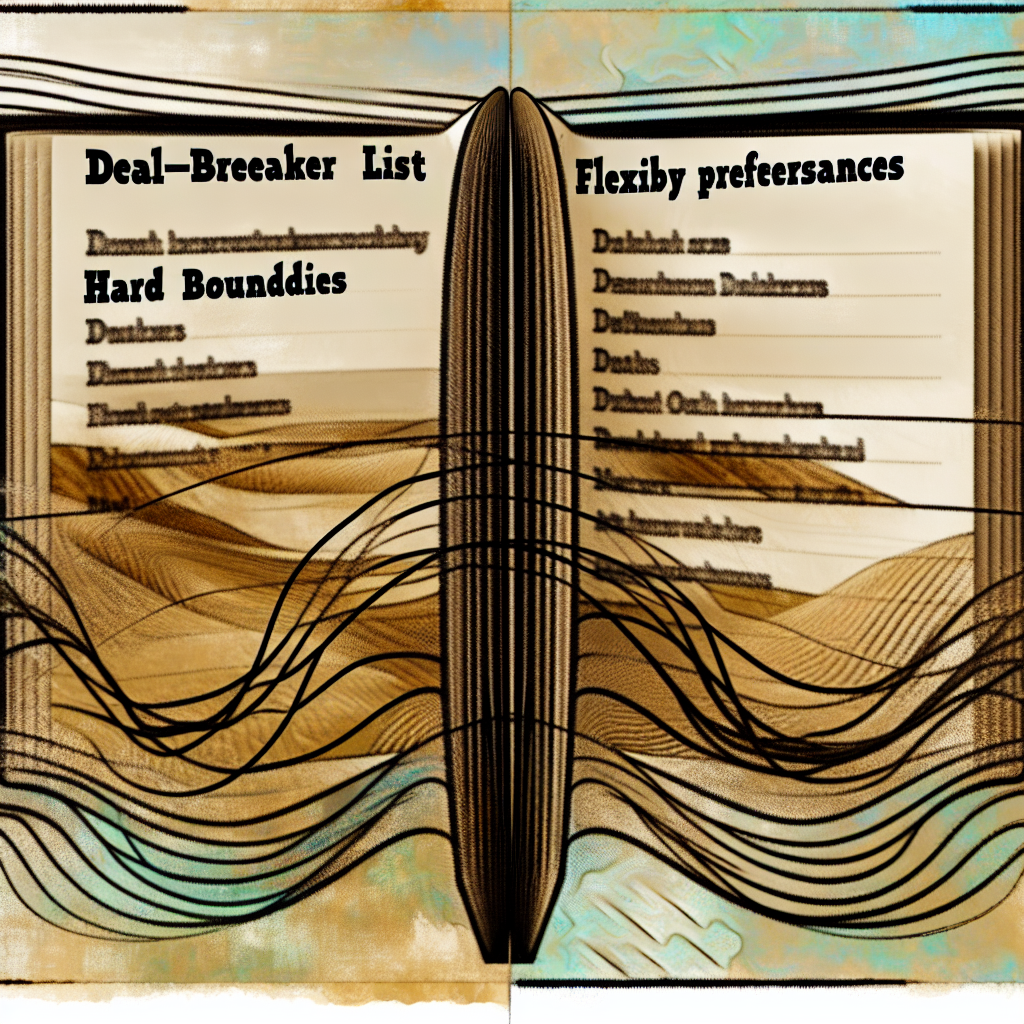
Then, categorize your list into two columns: “Non-Negotiable Boundaries” vs. “Flexible Preferences.” For example:
Non-Negotiable Boundaries:
– Emotional availability
– Mutual respect
– Consistent communication
– Sobriety or shared lifestyle if it relates to health/safety
– Honesty and loyalty
Flexible Preferences:
– Height
– Career choice
– Music or movie tastes
– Fashion sense
– Extracurricular interests
Check in with these categories occasionally. As your life circumstances or relationship experiences evolve, so will your priorities. That’s the beauty of making the list dynamic: it honors both your growth and your core.
Conclusion:
In the complex world of modern dating, reflecting on your personal deal-breaker list with an open yet grounded mindset can create room for self-alignment and more genuine romantic connections. By distinguishing between unshakable boundaries and adaptable preferences, daters of all ages can navigate the emotional labyrinth of dating with greater clarity, empathy, and personal strength.
Ultimately, your deal-breaker list is not a cage—it’s a compass directing you to relationships where you’re both respected and inspired. Keep it flexible, keep it honest, and let it evolve as you do.
Concise Summary:
The dynamic deal-breaker list helps daters distinguish between hard boundaries and flexible preferences, promoting emotionally healthy connections. As life circumstances shift, so should relationship expectations. Research shows people often prioritize superficial traits initially but find real satisfaction in relationships meeting deeper emotional needs. Differentiating between non-negotiables like emotional safety and adjustable traits like hobbies or style can lead to more authentic connections. The list should evolve with self-awareness, reflecting both personal growth and enduring values essential for well-being.
References:
– Joel, S., MacDonald, G., & Page-Gould, E. (2014). Wanting to stay and wanting to go: Unpacking the decision to stay in a romantic relationship. Personality and Social Psychology Bulletin
– Fletcher, G. J., Simpson, J. A., Thomas, G., & Giles, L. (1999). Ideals in intimate relationships. Journal of Personality and Social Psychology
– American Psychological Association. (2023). Boundaries: Why setting—and respecting—them matters. APA Psychology Topics