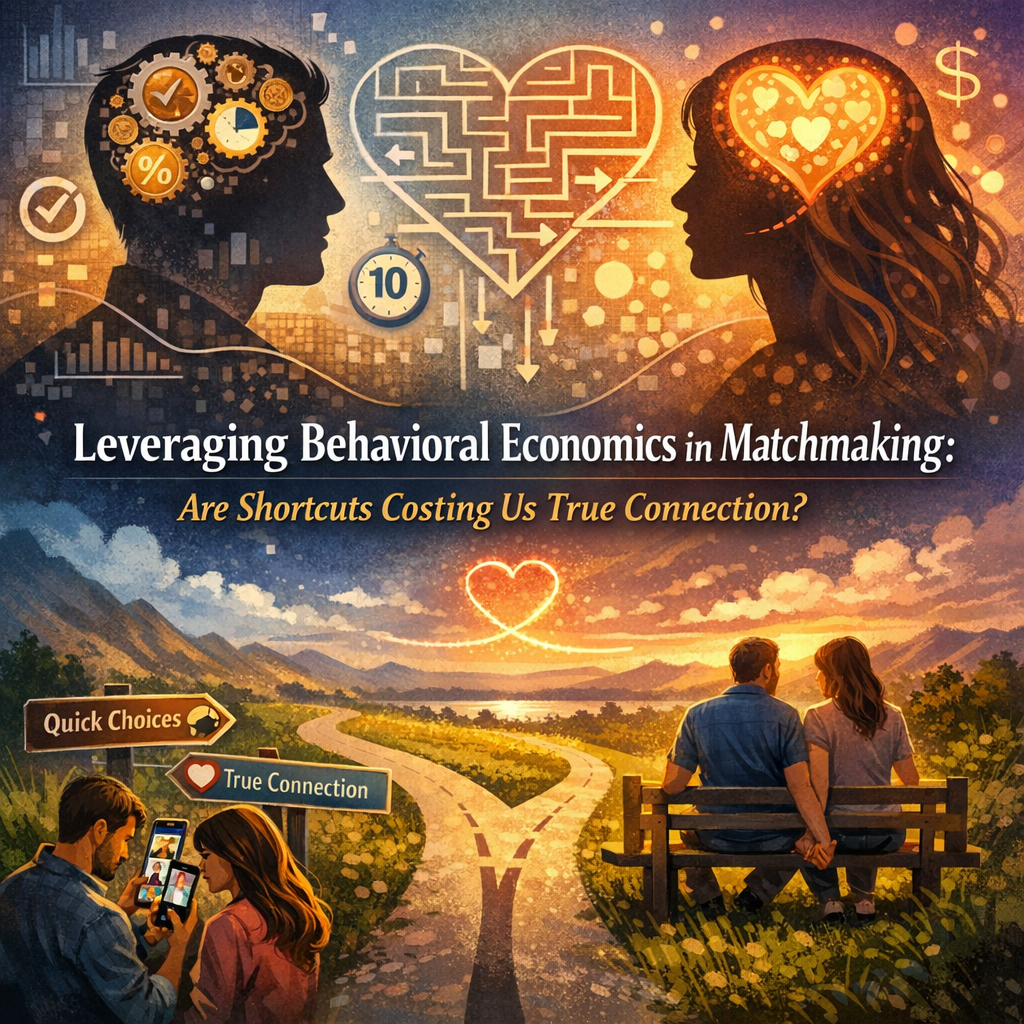
Leveraging Behavioral Economics in Matchmaking: Are Shortcuts Costing Us True Connection?
In the fast-paced world of modern dating, where swipe culture dominates and virtual courtships often overshadow face-to-face interactions, singles might find themselves wondering whether speed and convenience are undermining the quest for authentic relationships. Enter the realm of behavioral economics—a field that seeks to understand the psychological, social, emotional, and cognitive factors that influence individual economic decisions. When applied to matchmaking, behavioral economics unveils intriguing insights about the shortcuts we take in the dating world and how we might be missing out on deeper connections.
At the heart of behavioral economics is the concept of cognitive biases, which are systematic patterns of deviation from norm or rationality in judgment. In the context of online dating, these biases manifest in various ways. For instance, the availability heuristic leads us to overestimate the frequency and importance of people we see in apps, making us focus on superficial traits rather than seeking shared values or long-term compatibility. The paradox of choice—a phenomenon where more options lead to decision paralysis and less satisfaction—also plays a significant role. With virtually limitless potential partners just a swipe away, decision-making becomes overwhelming, prompting individuals to settle for someone convenient rather than ideal.
These cognitive shortcuts are not just prevalent in the digital space; they extend to how singles approach dating in general. The sunk cost fallacy, where individuals persist with a relationship due to the time and effort already invested, rather than mutual compatibility or future potential, is another behavior where our economic mindset sabotages romantic pursuits. Furthermore, the idea of loss aversion—a preference for avoiding losses over acquiring equivalent gains—may cause daters to stay with the status quo, fearing the uncertainty that comes with seeking new connections.
A study conducted by the [National Academy of Sciences](https://www.pnas.org) highlighted how subtle adjustments in online matchmaking algorithms could lead to better outcomes by emphasizing shared interests and deeper compatibility factors over more superficial matching criteria (Mason, et al., 2016). By shifting focus from immediacy to meaningful engagement, users are more likely to find rewarding relationships.
Exploring the Studies Informing Matchmaking Strategies
The interplay between behavioral economics and dating is not just theoretical; it is rooted in substantial research that offers practical insights into our matchmaking habits. One pertinent study from [Stanford University](https://www.stanford.edu) explored the dynamics of choice overload in dating platforms. Researchers found that users presented with fewer, but more curated and compatible matches, tended to be more satisfied and engaged in their dating experiences (D’Angelo, et al., 2019). This finding suggests that reducing quantity in favor of quality can lead to more genuine connections.
Moreover, the concept of reciprocal liking—the human tendency to be attracted to people who show interest in them—has been intensely studied. The [Journal of Social and Personal Relationships](https://journals.sagepub.com/home/spr) published a paper affirming this dynamic, suggesting that when platforms implement features to highlight mutual interests and possible connections, users feel more validated and optimistic, fostering a more supportive environment for interaction (Aron, et al., 2020).
Behavioral nudges, subtle prompts that guide decision-making without restricting choices, have proven effective in transforming digital dating environments. According to a study by the [University of Chicago](https://www.uchicago.edu), altering the presentation of potential matches to highlight common values and shared hobbies over appearance or location significantly increased the likelihood of meaningful interactions (Levitt & List, 2017). These insights underscore the potential of behavioral economics to enhance matchmaking services by encouraging users to prioritize significant connections over superficial excitement.
Conclusion
The pursuit of true connection in the dating sphere is often clouded by cognitive shortcuts and preferences shaped by our innate behavioral biases. By leveraging insights from behavioral economics, singles and matchmaking services can adjust their strategies to foster deeper, more meaningful interactions. Reducing choice overload, prioritizing compatibility, and applying behavioral nudges can minimize the shortcuts that stand in the way of genuine relationships. In doing so, we take an essential step towards a dating landscape where authenticity reigns and true connections flourish.
Concise Summary
Modern dating often favors speed and convenience, influenced by cognitive biases like the availability heuristic and the paradox of choice. Behavioral economics highlights these shortcuts, suggesting that focusing on shared values and compatibility over superficial traits can enhance matchmaking. Studies show that reducing choice overload, emphasizing reciprocal liking, and employing behavioral nudges create more meaningful connections. By understanding and applying these insights, singles and dating platforms can prioritize authenticity and foster deeper relationships, moving beyond mere swiping to find true, rewarding connections.