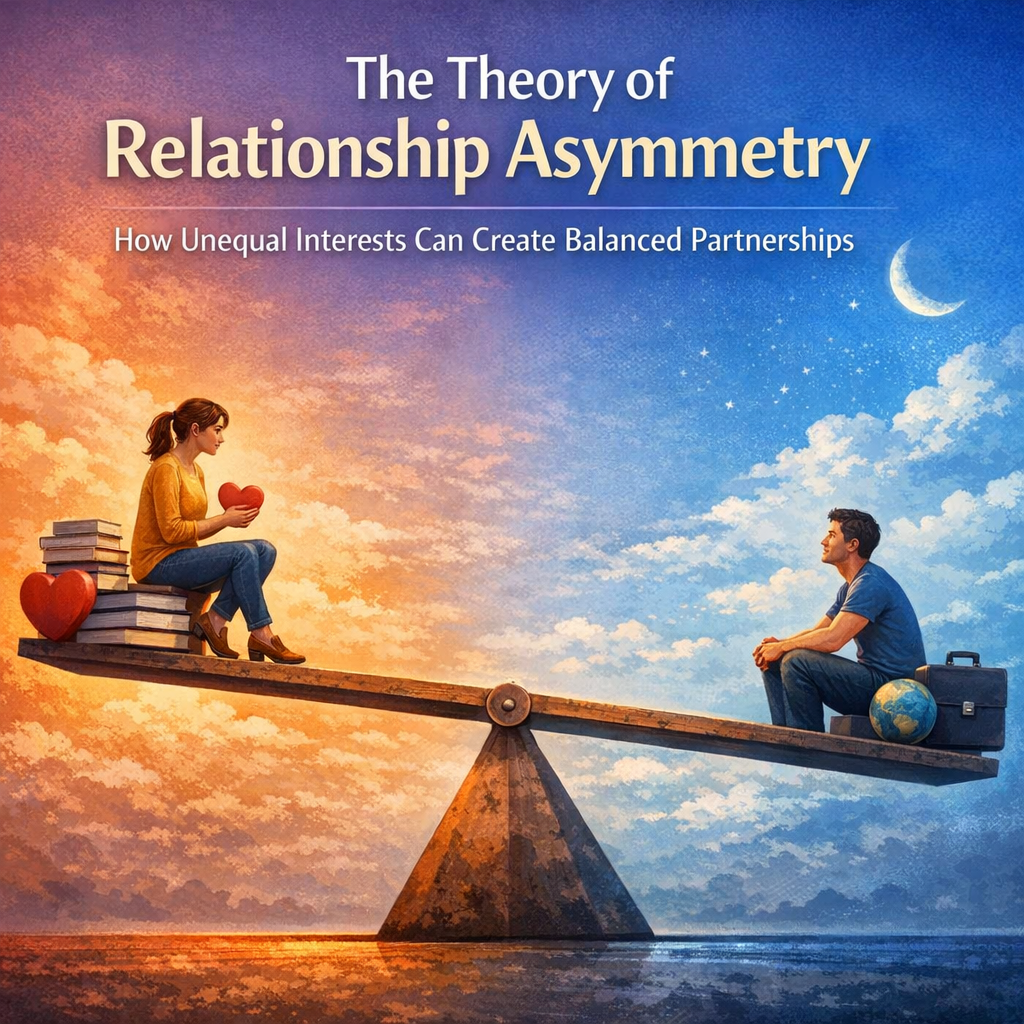
The Theory of Relationship Asymmetry: How Unequal Interests Can Create Balanced Partnerships
In the realm of romance and partnerships, the ideal of a perfectly symmetrical relationship — where both partners share identical interests, hobbies, and desires — has long been glorified. Yet, the reality for many is quite different. Enter the Theory of Relationship Asymmetry: the idea that partnerships can flourish even when partners have seemingly unequal interests. By examining this theory, singles from 18 to their 80s can gain a fresh perspective on creating balanced, fulfilling partnerships despite superficial differences.
Relationships where partners possess unequal interests might appear uneven, but such asymmetry can actually serve as fertile ground for personal growth, innovation, and balance. The very essence of partnership is collaboration, a pairing of complementary skills and characteristics. In an asymmetric relationship, each person brings unique strengths and perspectives to the table, enriching the union and adding depth to their shared experiences.
One classic example is the introvert-extrovert dynamic, which can initially seem challenging but often results in a well-rounded couple. While the extroverted partner might enjoy social gatherings and introductions, the introverted partner may prefer quieter evenings or one-on-one interactions. This contrast offers opportunities for both partners to step out of their comfort zones and appreciate life from diverse vantage points. Their relationship thrives because each individual respects the other’s preferences and learns from them, creating a richer tapestry of experiences than either would manage alone.
Insights from Studies and Experts
Delving into the scientific literature, relationship asymmetry gains further credibility through numerous studies. One such study by Dr. [Jeffrey Simpson](https://www.psych.umn.edu/people/simpson.htm), a psychology professor at the University of Minnesota, highlights how complimentary partnerships can achieve balance through differentiated roles. His research indicates that partners often optimize their strengths and compensate for each other’s weaknesses, creating a synergy that benefits the relationship as a whole.
A [Harvard Business Review](https://hbr.org/) article echoes these sentiments, suggesting that differences between partners can drive success by fostering an environment of continuous learning and adaptation. This is consistent with the principle that diversity, in various forms, promotes creativity and innovation — a theory widely acknowledged within organizations and teams, and similarly applicable to intimate partnerships.
Furthermore, the [University of Michigan](https://lsa.umich.edu/) conducted a longitudinal study exploring the dynamics of opposites attracting within relationships. The study revealed that couples with varying interests and personalities often developed more robust conflict resolution strategies. This was attributed to the partners’ predisposition to communicate and negotiate, skills necessitated by their inherent differences.
An intriguing exploration by the [Gottman Institute](https://www.gottman.com/) also suggests that successful long-term relationships often thrive on the partners’ ability to navigate and appreciate their differences. According to Dr. John Gottman’s research, seemingly asymmetric traits can lead to a dynamic interplay within a relationship, where each partner’s distinct perspectives contribute to a stable and lasting partnership.
These professional insights underscore the potential of relationship asymmetry to foster growth and synchronization. Rather than diminishing a partnership’s integrity, these studies suggest that embracing disparity can optimize relationship satisfaction, providing partners are committed to empathy and open communication.
Conclusion
While the Theory of Relationship Asymmetry challenges traditional notions of romantic symmetry, it offers a powerful framework for understanding how unequal interests can enhance rather than hinder a relationship. By embracing diverse perspectives and developing robust communication skills, singles can find balance and harmony in their relationships. Ultimately, these partnerships prove that in love, variety can be a vibrant, enriching component, fostering deeper connections and shared growth.
Concise Summary
The Theory of Relationship Asymmetry suggests that partnerships thrive not through symmetry but by embracing differing interests and perspectives. Such relationships foster personal growth, empathy, and innovation, leveraging complementary strengths. Examples include the introvert-extrovert dynamic, which enhances shared experiences. Studies by experts like Dr. Jeffrey Simpson and research from institutions like the University of Michigan and the Gottman Institute affirm that asymmetry enriches relationships. By valuing diversity and maintaining communication, partners can build balanced, fulfilling connections, demonstrating that variety is a powerful, vibrant aspect of love.