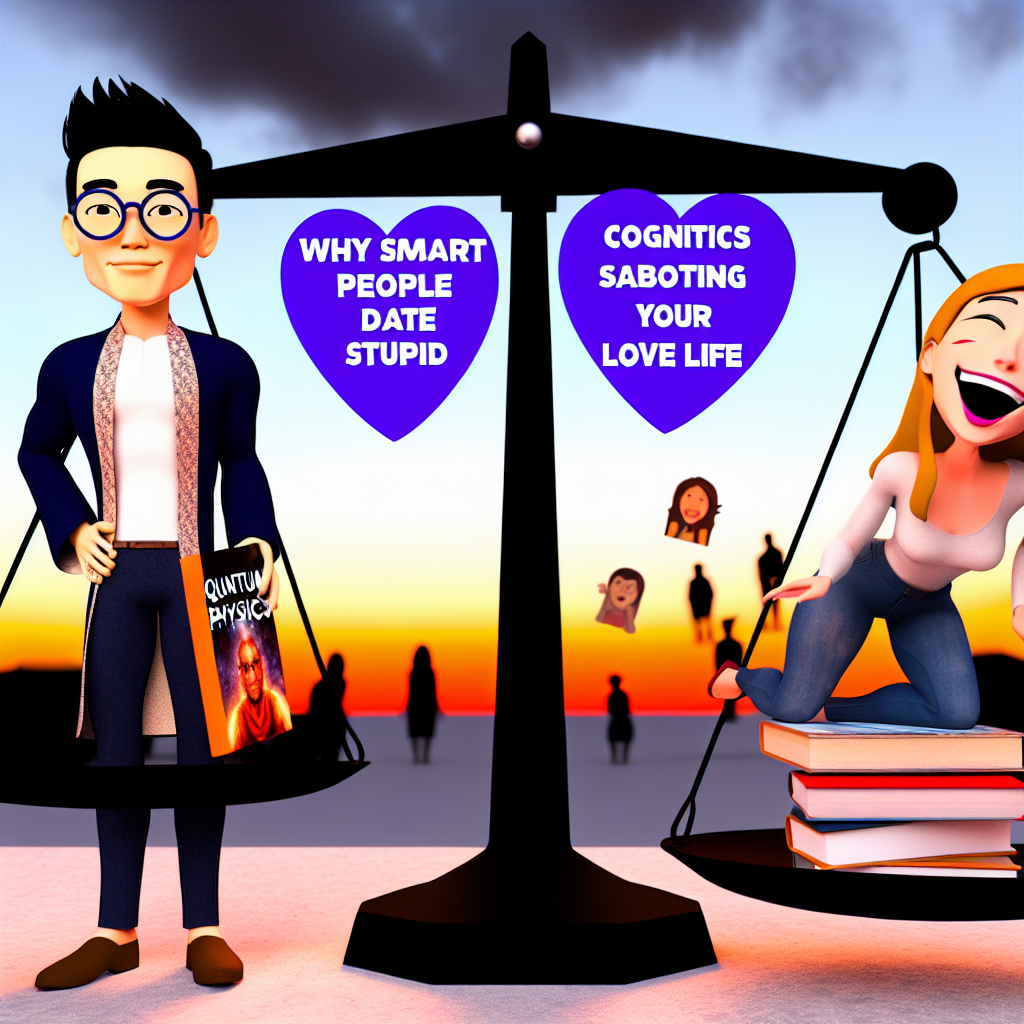
Why Smart People Date Stupid: Cognitive Biases Sabotaging Your Love Life
Introduction
In a world full of romantic comedies and fairy tales, one might think that intelligent people would make smart decisions in love. Yet, puzzlingly, some of the brightest minds find themselves dating unsuitable partners. This is not simply about **brains versus brawn**, but rather the effect of cognitive biases that cloud judgment. These biases evolved as survival mechanisms but now skew perception in modern dating.
One example is **confirmation bias**, where people focus only on information that supports their desires. For instance, an enamored person might overlook a partner’s tardiness by focusing on shared interests instead. The **halo effect** is another, where a single positive trait, like attractiveness, overshadows flaws, causing intellect to falter against superficial assessments.
Furthermore, the fear of loneliness, social conformity, and the pressure to “settle down” lead intelligent individuals into poor relationships. The **availability heuristic** deceives them into thinking what is immediately available is ideal, even when intuition suggests otherwise.
Understanding these psychological pitfalls helps explain why smart people find themselves in unsuitable relationships, and it empowers them to change their love stories.
Features
**Scientific studies** on cognitive biases provide insight into how these mental shortcuts affect romantic choices. Psychologist and **Nobel Laureate Daniel Kahneman** reveals these biases are deeply ingrained in decision-making, often misguiding intelligent individuals ([source](https://en.wikipedia.org/wiki/Thinking,_Fast_and_Slow)).
A study by Assouline and Meir (2013) highlights **over-confidence bias**, where intelligent people believe they can reshape unsuitable partners, thus harming their relational well-being. The **halo effect** is examined further by Nisbett and Wilson (1977), showing how attractiveness affects perceptions of intelligence, explaining why smart people ignore compatibility issues.
**Lenton et al. (2008)** conducted a meta-analysis on the availability heuristic’s effect in dating, finding that choice abundance can lead to poor decisions, even for the most intelligent ([Journal of International Consumer Marketing](#)). This underscores how decision fatigue affects partner selection.
Combining **these biases** creates a complex psychological tapestry, illustrating how innate mental shortcuts, while useful in high-pressure situations, can lead to poor dating decisions. Recognizing these biases is key to overcoming their effects and pursuing genuine compatibility.
Conclusion
Intelligent individuals often seek understanding in their world, yet they may miss blind spots in love due to **cognitive biases**. Recognizing these mental pitfalls empowers smarter relationship choices based on authentic compatibility and mutual respect rather than initial impressions. By addressing these biases, individuals aged 18 to 80 can find deeper, more fulfilling relationships.
References
– Daniel Kahneman, [*Thinking, Fast and Slow*](https://en.wikipedia.org/wiki/Thinking,_Fast_and_Slow). (2011).
– Assouline, S. G., & Meir, I. (2013). “Intellectual arrogance among intellectual youth: An empirical examination.” *Gifted Child Quarterly*.
– Nisbett, R. E., & Wilson, T. D. (1977). “The halo effect: Evidence for unconscious alteration of judgments.” *Journal of Personality and Social Psychology*.
– Lenton, A. P., Fasolo, B., & Todd, P. M. (2008). “The relationship between choice and loneliness: The paradox of choice in the singleton context.” *Journal of International Consumer Marketing*.
**Concise Summary:**
Despite intelligence, many fall victim to cognitive biases like confirmation bias, halo effect, and availability heuristic in romantic decisions. These biases skew perception, leading to unsuitable relationships. Awareness of these pitfalls empowers individuals to forge connections based on genuine compatibility and mutual respect, fostering healthier relationships free from cognitive distortions.

Dominic E. is a passionate filmmaker navigating the exciting intersection of art and science. By day, he delves into the complexities of the human body as a full-time medical writer, meticulously translating intricate medical concepts into accessible and engaging narratives. By night, he explores the boundless realm of cinematic storytelling, crafting narratives that evoke emotion and challenge perspectives. Film Student and Full-time Medical Writer for ContentVendor.com