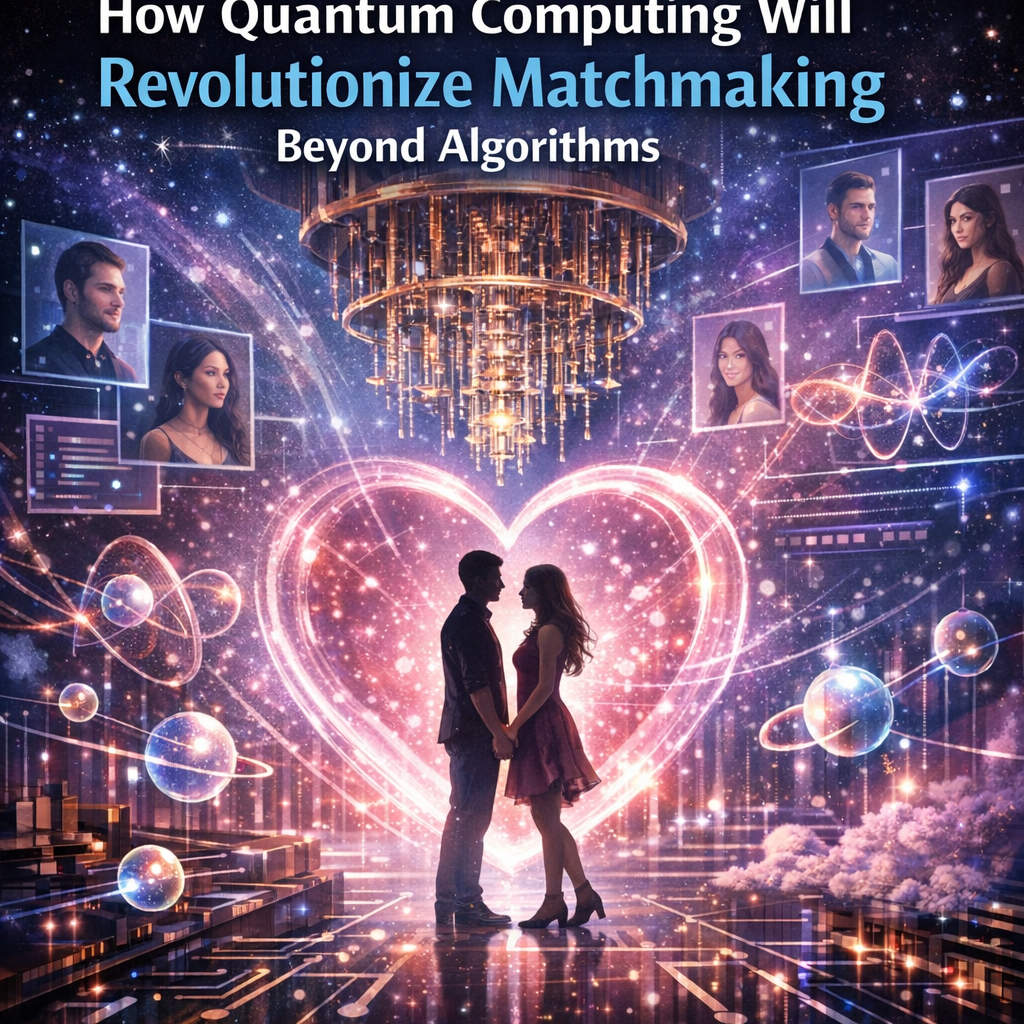
How Quantum Computing Will Revolutionize Matchmaking Beyond Algorithms
In the evolving landscape of technology, where the digital and physical realms blend seamlessly, the world of matchmaking is on the brink of a revolutionary transformation. As singles between the ages of 18 to 80 navigate the dynamic aisles of dating platforms, the promise of quantum computing emerges as a beacon of hope. But what is quantum computing, and how can it transcend the capabilities of traditional algorithms in matchmaking?
Introduction
Quantum computing is poised to redefine numerous industries, from finance and logistics to cryptography and artificial intelligence. The underlying principle of quantum computing revolves around the peculiar properties of quantum bits, or qubits. Unlike classical bits that inhabit binary states of 0 and 1, qubits exist in superpositions, capable of processing complex computations at unprecedented speeds. This computational dexterity, coupled with entanglement, where qubits remain interconnected regardless of distance, introduces a new paradigm of problem-solving prowess.
When applied to matchmaking, quantum computing holds the potential to unravel the intricacies of human connections, far surpassing traditional algorithmic approaches. At the crux of matchmaking lies the intricate web of human emotions, preferences, and compatibility metrics, often too complex for classical algorithms to decipher accurately. Despite advances in AI and machine learning, existing matchmaking algorithms struggle to account for the full spectrum of human variables—values, cultural nuances, evolving preferences, and psychological subtleties.
With quantum computing, the dating landscape could enter an era where matchmaking transcends surface-level common interests and delves into deeper compatibility factors. Quantum computers can sift through vast data sets with lightning-fast speed, applying quantum algorithms that can recognize patterns and correlations otherwise imperceptible to classical algorithms. Imagine a quantum system smart enough to predict compatibility not based on static profiles but on dynamic and evolving human behaviors, preferences, and interpersonal chemistry.
The potential applications extend beyond just recommendations. Quantum computing could, hypothetically, simulate complex neurological responses or emotional states in different matchmaking scenarios, tailoring interactions and match suggestions that resonate more authentically with individual personalities. While this might sound like science fiction, interdisciplinary research between quantum physics, cognitive science, and relationship psychology is fertile ground, poised to deliver tomorrow’s matchmaking miracles today.
Features
Several professional and academic studies illuminate how quantum computing might interface with the matchmaking domain. One study from Harvard University explores the concept of quantum preference modeling. This research delves into using quantum decision models to capture the probabilistic nature of human preferences and choices over traditional deterministic methods ([Harvard Quantum Initiative](https://quantum.harvard.edu)). By simulating choices in a quantum system, the study anticipates predicting more nuanced consumer choices, applicable directly to personal relationships.
Moreover, a collaborative study between MIT Media Lab and the University of Oxford investigates quantum-enhanced machine learning. The research focuses on utilizing quantum computers to proffer machine learning algorithms that exponentially improve data pattern recognition ([MIT-IBM Watson AI Lab](https://mitibmwatsonailab.mit.edu)). The implications for matchmaking are significant: enhanced recognition of user behavior patterns and relationship dynamics could drive highly personalized and successful matchmaking experiences.
From a psychological standpoint, theories rooted in quantum cognition are gaining traction, suggesting that the mind might operate in a quantum-like fashion when making decisions. A paper published in “Neuroscience & Biobehavioral Reviews” proposes frameworks for understanding complex human emotions and decision-making processes through the lens of quantum mechanics ([Neuroscience Review](https://www.sciencedirect.com/journal/neuroscience-and-biobehavioral-reviews)). The integration of these cognitive models with quantum computing could lead to profound advancements in creating more sophisticated end-user matchmaking experiences.
These interdisciplinary approaches underscore quantum computing’s potential in reshaping matchmaking beyond the finite algorithms of today. However, challenges persist. The nascent nature of quantum technologies presents computational, ethical, and privacy concerns that require careful navigation. Yet, as these scientific inquiries advance, the pathway toward quantum-enhanced matchmaking continues to crystallize.
Conclusion
Quantum computing’s advent marks a transformative epoch for the dating world, transcending the traditional matchmaking algorithmic bounds. As research converges across technological and psychological disciplines, quantum computing promises not merely to enhance compatibility predictions but to redefine the very essence of how connections are understood. In summary, the dawn of quantum computing heralds an age where technology—and love—intertwine more intricately and naturally than ever before, offering boundless new horizons for singles seeking enduring, meaningful relationships in the digital age.
Concise Summary:
Quantum computing has the potential to revolutionize matchmaking by surpassing traditional algorithms in understanding complex human emotions and compatibility metrics. By leveraging qubits and quantum algorithms, it can delve deeper into compatibility factors, predicting matches based on dynamic human behaviors. Research suggests that integrating quantum physics with cognitive science may lead to more authentic matchmaking experiences. Despite challenges like privacy and computational concerns, quantum computing promises to redefine how connections are cultivated, offering a transformative approach to finding meaningful relationships in the digital era.