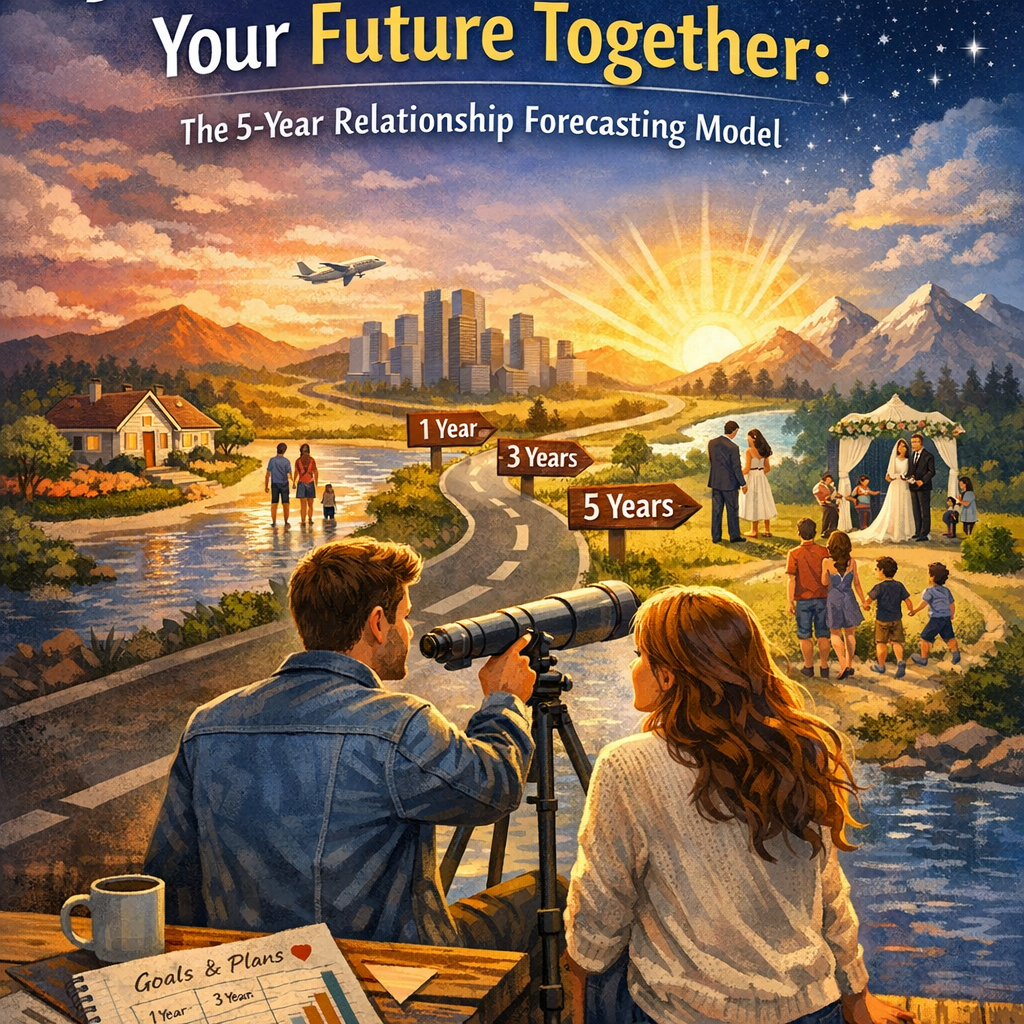
How to Predict Your Future Together: The 5-Year Relationship Forecasting Model
Introduction
Navigating the tumultuous seas of a romantic relationship can often feel like an intricate dance, blending spontaneity and strategic foresight. At every stage of your relationship, from the exhilarating early days of courtship to the stability afforded by years of companionship, understanding where you’re headed is crucial. For singles and couples alike, the 5-year relationship forecasting model emerges as a tool designed to anticipate the evolution of your romantic journey, empowering you to make proactive decisions for lasting happiness.
At its core, relationship forecasting is a strategic process that involves evaluating both current dynamics and potential future scenarios. By doing so, it helps partners identify significant markers that predict the health and trajectory of their relationship. The intention isn’t to enforce rigid predictability but to offer a roadmap that can guide couples towards a harmonious future.
Traditionally, relationships were shaped by cultural expectations and family influences; however, today’s digital age has introduced greater complexity. Individuals now have more autonomy—and often confusion—over where relationships stand and where they are heading. Herein lies the utility of the 5-year model: it provides a structured framework for reflection and conversation, allowing singles to assess compatibility early and encouraging couples to collaboratively map out their shared goals.
This model rests on several key components: emotional intelligence, shared values, mutual growth, future aspirations, and conflict resolution skills. By focusing on these critical pillars, individuals can better understand whether they and their partners are likely to weather storms or succumb to relationship fatigue over time. Moreover, by asking the right questions at the appropriate junctures, and embracing vulnerability in communication, singles and couples can cultivate resilience and a deeper connection.
While the model doesn’t eliminate the natural unpredictability of life, it arms partners with insight and guidance. Think of it as a GPS for romance—a nuanced understanding of where you are, where you wish to be, and what it will take to get there.
Features
Research supports the value of predicting relationship outcomes through careful analysis and intentional dialogue. For instance, a study published in the [Journal of Marriage and Family](https://onlinelibrary.wiley.com/journal/17413737) highlights that couples who engage in future-oriented conversations demonstrate higher levels of satisfaction and stability. These discussions enable partners to align their goals and expectations, reducing the likelihood of conflicts arising from unmet needs or divergent life paths.
Additionally, research by the [Gottman Institute](https://www.gottman.com/) underscores the significance of what they term “love maps.” According to Dr. John Gottman, a renowned relationship psychologist, couples with detailed knowledge about each other’s worlds are more adept at managing conflict and nurturing affection. This aligns with the forecasting model’s emphasis on emotional intelligence and understanding—a central component in predicting and ensuring a relationship’s sustainability.
Furthermore, studies by [Psychological Science](https://journals.sagepub.com/home/pss) reveal that individuals who prioritize adaptability and mutual growth are better prepared for life changes that could otherwise derail a relationship. This adaptability is central to the 5-year model, urging couples to plan for flexibility rather than rigidity. The model acknowledges that life is unpredictable and encourages partners to embrace change as an opportunity for shared growth rather than a threat to the relationship.
The concept of relationship forecasting is also bolstered by theories of relationship resilience found in sociology studies. Researchers from the [University of California, Los Angeles](http://soc.ucla.edu/) highlight how couples that anticipate future challenges and actively plan for them are better equipped to handle crises, whether related to career, health, or family dynamics. Preparing for possible trials fosters a sense of security and joint determination, pivotal factors in relationship longevity.
Taken together, these academic and professional insights illustrate that the 5-year relationship forecasting model is grounded in scientific evidence, offering a robust approach to predicting and enhancing romantic dynamics.
Conclusion
In summary, embarking on the journey of predicting your future together through the 5-year relationship forecasting model invites both introspection and open dialogue. By focusing on critical competencies like emotional intelligence, shared aspirations, and adaptability, singles and couples can ensure a healthier, more fulfilling relationship. Ultimately, while love might not be entirely predictable, thoughtful planning can pave the way for a harmonious and rewarding future. Embrace the adventure with curiosity and commitment—this is the essence of a successful partnership.
References
– [Journal of Marriage and Family](https://onlinelibrary.wiley.com/journal/17413737)
– [The Gottman Institute](https://www.gottman.com/)
– [Psychological Science](https://journals.sagepub.com/home/pss)
– [University of California, Los Angeles Sociology Studies](http://soc.ucla.edu/)
Concise Summary
The 5-year relationship forecasting model is a strategic approach to guide singles and couples toward lasting happiness by assessing current dynamics and future possibilities. It emphasizes crucial components like emotional intelligence, shared values, and adaptability. Supported by research, the model suggests that future-focused conversations enhance relationship satisfaction and stability. Through academic insights, it outlines strategies to manage unpredictability and nurture resilience, thus providing a roadmap for shared growth and harmonious futures.